
The short answer
A torn ACL is not an emergency. Once the ACL tears, it typically does not heal on its own, so the real question is whether your life calls for a new ligament: most young, active people who play cutting and pivoting sports choose reconstruction, while many adults with less demanding activities do well with physical therapy alone. Give the knee two to three weeks to calm down, stay out of pivoting sports, and decide with a sports medicine surgeon who examines your knee and reviews the MRI with you.
What does the ACL do, and why doesn't a torn ACL heal?
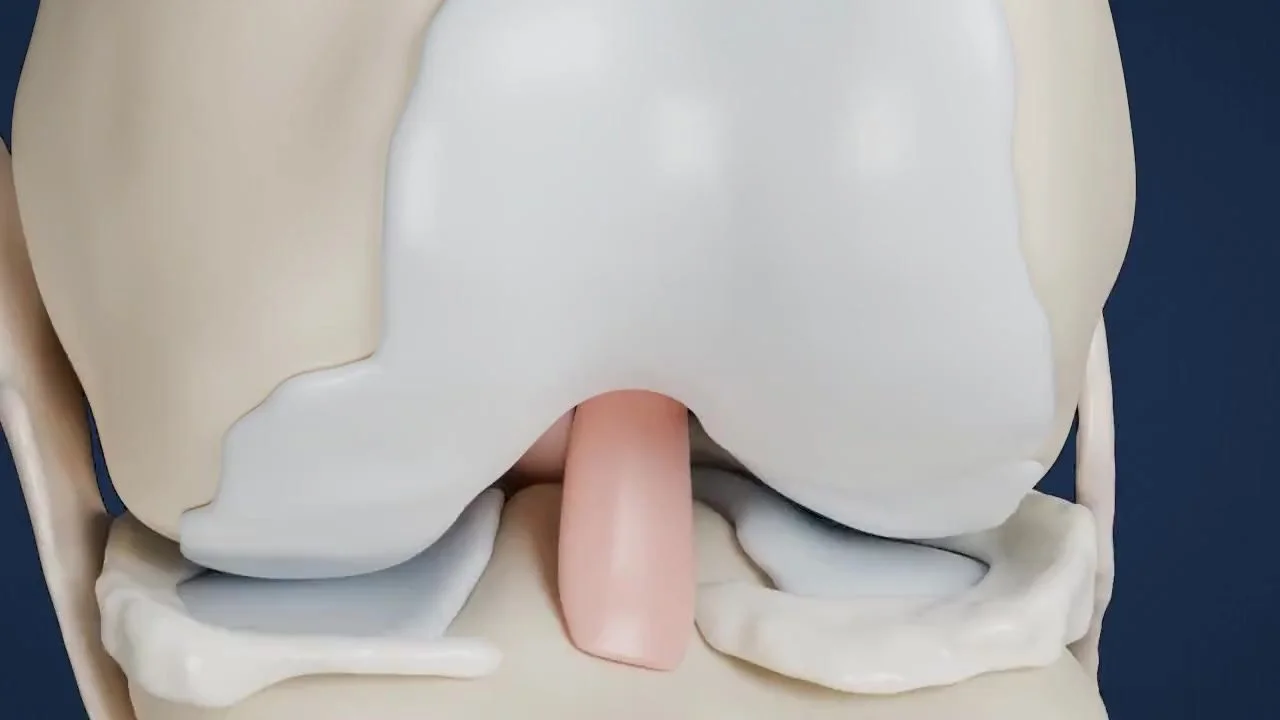
The anterior cruciate ligament (ACL) sits inside the knee and keeps the shinbone from sliding and rotating under the thighbone when you plant, cut, or land. After a tear the knee hurts and swells, then settles down. Within two to three weeks, many people are walking around as if nothing happened.
That calm can be misleading. A sprained MCL on the inside of the knee heals on its own. The ACL does not. As Dr. Raynor tells patients, "ACLs are really bad at healing on their own. The difference between those two is that the ACL's inside the knee, and stuff inside the knee doesn't heal very well."
Without an ACL, the problem is usually instability, not pain: the knee feels fine for daily life, then gives way on the court or the slope.
Does everyone with a torn ACL need surgery?
No. Dr. Raynor treats it as a decision with options, and the right one depends on how you use your knee.
Adults whose activities are mostly straight-line (the gym, cycling, running, work) and whose knee does not give way in daily life can often do well without reconstruction. For them, physical therapy to rebuild the thigh muscles is a legitimate treatment, and as Dr. Raynor says, "PT is never the wrong answer." In a Swedish randomized trial of 121 young, active adults, those who started with rehab and had surgery only if needed did as well at five years as those reconstructed early, and about half never had a reconstruction (Frobell et al., 2013).
Most people who choose surgery are young athletes, people who want to return to soccer, basketball, tennis, pickleball, or skiing, and anyone whose knee keeps giving way. The non-surgical path has one firm rule: no cutting and pivoting on an unstable knee.
When should I have ACL surgery?
There is such a thing as too soon. Dr. Raynor usually waits about three weeks so swelling settles and motion returns; recovery goes faster when surgery is not stacked on a fresh injury. A session or two of "prehab" helps too.
There is no rush after that. In his words, "the surgery is the same if I do it now, versus six months from now, versus a year from now." That holds as long as the meniscus and cartilage stay healthy in the meantime. What changes with time is the rest of the knee: Dr. Raynor warns that giving-way episodes can tear a meniscus or damage cartilage, and studies link longer delays to more of both (Granan et al., 2009; Sanders et al., 2016). Waiting for a season to end is fine; pivoting on an unstable knee is not.
What does ACL reconstruction involve?
ACL reconstruction is outpatient surgery: you are asleep, you get a nerve block, and you go home the same day. Dr. Raynor explains it in five steps:
Two little poke holes for the camera and instruments.
Take out your old, torn ACL.
Drill a tunnel in the femur (thighbone) where it's supposed to go.
Drill a tunnel in the tibia (shinbone) where it's supposed to go.
Put your new graft in and fix it in place.
The graft can be your own patellar tendon, quadriceps tendon, or hamstrings, or donor tissue; Dr. Raynor calls the patellar tendon autograft the gold standard. A torn meniscus gets repaired whenever the tissue allows. More on how Dr. Raynor performs ACL reconstruction.
What does recovery look like after ACL surgery?
You walk on the leg right away, with crutches and a brace for about three to four weeks (a meniscus repair can change how much weight you put on it for the first six weeks). The ligament is basically healed at around three months, when jogging starts. Cutting and pivoting drills wait until the quadriceps is back to about 90 percent of the other side and you are at least four months out; most people get there around five months. Full return to sport is seven to nine months, after passing a sport test. "You're not bored for seven months," Dr. Raynor says. "It's a long recovery, but it's a very active recovery." The ACL recovery roadmap walks through it stage by stage.
If you already have an MRI showing an ACL tear, the Fast Track page explains how to get on Dr. Raynor's schedule with an existing diagnosis.
What the research shows about ACL surgery timing
Long delays cost cartilage and meniscus. In 3,475 Norwegian reconstructions, the odds of cartilage damage rose by roughly half a percent for every month between injury and surgery (Granan et al., 2009). In a Mayo Clinic population study, people reconstructed a year or more after injury were about four times as likely to develop a later meniscus tear as those reconstructed within the first year (Sanders et al., 2016). Both are observational studies.
Patience before sport pays off. Knee reinjury risk fell 51 percent for each month return to sport was delayed, up to nine months (Grindem et al., 2016).
The Bottom Line
A torn ACL usually does not heal, but it is rarely urgent. Let the knee calm down, avoid pivoting, and plan around what you want to get back to. For people who want to cut and pivot again, reconstruction is a reliable outpatient operation followed by seven to nine months of active rehab.
References
Frobell RB, Roos HP, Roos EM, Roemer FW, Ranstam J, Lohmander LS. Treatment for acute anterior cruciate ligament tear: five year outcome of randomised trial. BMJ. 2013;346:f232. doi:10.1136/bmj.f232 PMID: 23349407.
Granan LP, Bahr R, Lie SA, Engebretsen L. Timing of anterior cruciate ligament reconstructive surgery and risk of cartilage lesions and meniscal tears: a cohort study based on the Norwegian National Knee Ligament Registry. Am J Sports Med. 2009;37(5):955-961. doi:10.1177/0363546508330136 PMID: 19251674.
Sanders TL, Maradit Kremers H, Bryan AJ, et al. Is anterior cruciate ligament reconstruction effective in preventing secondary meniscal tears and osteoarthritis? Am J Sports Med. 2016;44(7):1699-1707. doi:10.1177/0363546516634325 PMID: 26957217.
Grindem H, Snyder-Mackler L, Moksnes H, Engebretsen L, Risberg MA. Simple decision rules can reduce reinjury risk by 84% after ACL reconstruction: the Delaware-Oslo ACL cohort study. Br J Sports Med. 2016;50(13):804-808. doi:10.1136/bjsports-2016-096031 PMID: 27162233.