
The short answer
There is no single best ACL graft for everyone, but for young athletes the strongest evidence favors using your own tissue, and Dr. Raynor's default is the patellar tendon autograft. The quadriceps tendon is an equally sound choice and the better one for teenagers whose growth plates are still open or for people who kneel a lot. Donor grafts are generally not a first choice for young, active patients because they fail more often in that group.
What are the four ACL graft options?
When Dr. Raynor reconstructs an ACL, he removes the torn ligament, drills a tunnel in the femur and one in the tibia, and passes a new graft through them. That graft can come from four places:
Donor tissue (allograft): a tendon from a tissue bank.
Patellar tendon autograft: the middle third of your own patellar tendon, with a small plug of bone from the kneecap and the shinbone on each end.
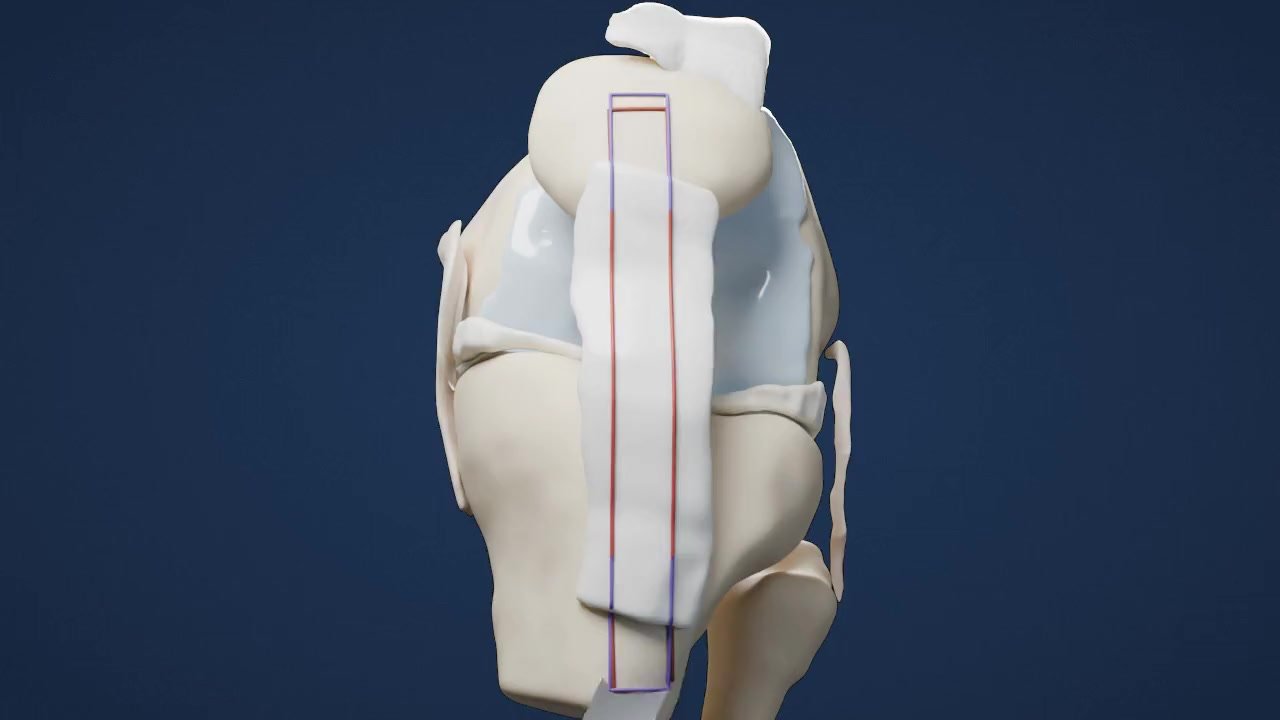
Quadriceps tendon autograft: a strip from the middle of your own quadriceps tendon, just above the kneecap.
Hamstring autograft: one or two of your own hamstring tendons from the back of the thigh.
He lists all four for every patient, then narrows the choice based on age, sport, and growth plates. For most patients it comes down to patellar tendon or quad, and in his words, "There's no wrong answer between those two."
Why does Dr. Raynor call the patellar tendon graft the gold standard?
The patellar tendon graft has the longest track record of any ACL graft, and its bone plugs heal into the bone tunnels. As Dr. Raynor tells patients, "The gold standard is still the patellar tendon autograft." It is what all of his athletes under 20 with closed growth plates get by default, and he puts it plainly: "If you said, 'Raynor, you can only use one graft forever for the rest of your life,' I would use a patellar tendon autograft on everybody."
The trade-offs are honest ones. There is a scar on the front of the knee, the skin beside it is usually numb, and kneeling on it can be uncomfortable. There is also a small risk of kneecap fracture from the bone harvest, which he works to avoid by backfilling the harvest sites with bone saved from drilling the tunnels and closing the tendon back together.
When is the quad tendon the better choice for ACL reconstruction?
The quadriceps tendon performs about as well as the patellar tendon. A meta-analysis of 27 studies found no difference in knee stability, function scores, or graft failure between the two, and much less pain at the harvest site with the quad (Mouarbes et al., 2019). Dr. Raynor chooses it in three situations:
Teenagers with growth plates still open. A patellar tendon graft puts bone across the growth plate, which can stop part of it and leave a crooked leg. A quad graft is all soft tissue, held with small buttons, so nothing hard crosses the growth plate. Dr. Raynor checks bone age with hand and elbow X-rays before deciding. In patients 18 and under overall (not only those with open growth plates), a pooled analysis found quad failure at 2.7 percent and patellar tendon at 7.9 percent, though the quad data came from far fewer patients followed for less than half as long (Petit et al., 2024).
People who kneel. Wrestlers, people who do yoga often, and anyone whose job puts them on their knees often prefer the quad because the incision is not right on the front of the knee.
Patient preference. Both are good grafts, and some people simply prefer the quad's incisions.
The trade-off, in his experience, is that the quad muscle can take a month or two longer to get strong, so return to sport can run a bit longer. That matters most when a high school season is on the line.
Why not use a donor ACL graft in young athletes?
Donor tissue means no harvest site, a smaller incision, and an easier early recovery. The problem is durability in young, active people. In a systematic review of patients under 25 or highly active, donor grafts failed in 25.0 percent of cases versus 9.6 percent for the patient's own tissue (Wasserstein et al., 2015). In the MOON cohort of 2,683 reconstructions, the odds of re-tearing a donor graft were 5.2 times those of a patellar tendon autograft, and the risk climbed with younger age and higher activity (Kaeding et al., 2015). Dr. Raynor generally reserves donor grafts for patients over 40 with lower-demand activities, and even then he prefers your own tissue if you still play competitive sports.
Is a hamstring graft still an option for ACL surgery?
Yes. In the MOON cohort (average age 27), researchers found no significant difference in re-tear between hamstring and patellar tendon autografts (Kaeding et al., 2015). In younger patients the picture changes: hamstring grafts failed in 11.8 percent of patients 18 and under (Petit et al., 2024), and in a 20-year Australian series only 61 percent of hamstring grafts in adolescents survived (Salmon et al., 2018). Because the quad tendon now offers an all-soft-tissue option with encouraging early results, though with less long-term data, Dr. Raynor rarely uses hamstrings today.
The Bottom Line
The best graft is the one matched to your age, your growth plates, your sport, and whether you kneel. For most young athletes that means a patellar tendon or quad tendon autograft, with the patellar tendon as Dr. Raynor's default and the quad as an equal alternative. To see both grafts in action, watch Dr. Raynor's narrated step-by-step animations of ACL reconstruction with a patellar tendon graft and ACL reconstruction with a quadriceps tendon graft. Learn more about ACL tears and how Dr. Raynor performs ACL reconstruction. If you already have an ACL diagnosis, the Fast Track page explains how to be seen.
References
Mouarbes D, Menetrey J, Marot V, Courtot L, Berard E, Cavaignac E. Anterior cruciate ligament reconstruction: a systematic review and meta-analysis of outcomes for quadriceps tendon autograft versus bone-patellar tendon-bone and hamstring-tendon autografts. Am J Sports Med. 2019;47(14):3531-3540. doi:10.1177/0363546518825340 PMID: 30790526.
Petit CB, Hussain ZB, McPherson A, et al. Graft failure in pediatric patients after bone-patellar tendon-bone, hamstring tendon, or quadriceps tendon autograft ACLR: a systematic review and meta-analysis. Orthop J Sports Med. 2024;12(11):23259671241289140. doi:10.1177/23259671241289140 PMID: 39583150.
Wasserstein D, Sheth U, Cabrera A, Spindler KP. A systematic review of failed anterior cruciate ligament reconstruction with autograft compared with allograft in young patients. Sports Health. 2015;7(3):207-216. doi:10.1177/1941738115579030 PMID: 26131297.
Kaeding CC, Pedroza AD, Reinke EK, et al. Risk factors and predictors of subsequent ACL injury in either knee after ACL reconstruction: prospective analysis of 2488 primary ACL reconstructions from the MOON cohort. Am J Sports Med. 2015;43(7):1583-1590. doi:10.1177/0363546515578836 PMID: 25899429.
Salmon LJ, Heath E, Akrawi H, Roe JP, Linklater J, Pinczewski LA. 20-year outcomes of anterior cruciate ligament reconstruction with hamstring tendon autograft: the catastrophic effect of age and posterior tibial slope. Am J Sports Med. 2018;46(3):531-543. doi:10.1177/0363546517741497 PMID: 29244525.