
The short answer
Most of the time, no. After a first kneecap dislocation, about 1 in 3 people had it happen again during the studies' follow-up, so most did not (Huntington et al., 2020). That is why Dr. Brett Raynor, a sports medicine surgeon in Dallas, treats most first-time kneecap dislocations without surgery and saves surgery for kneecaps that keep coming out or for a piece of cartilage and bone that has broken off and needs to be removed or fixed.
What happens when your kneecap dislocates?
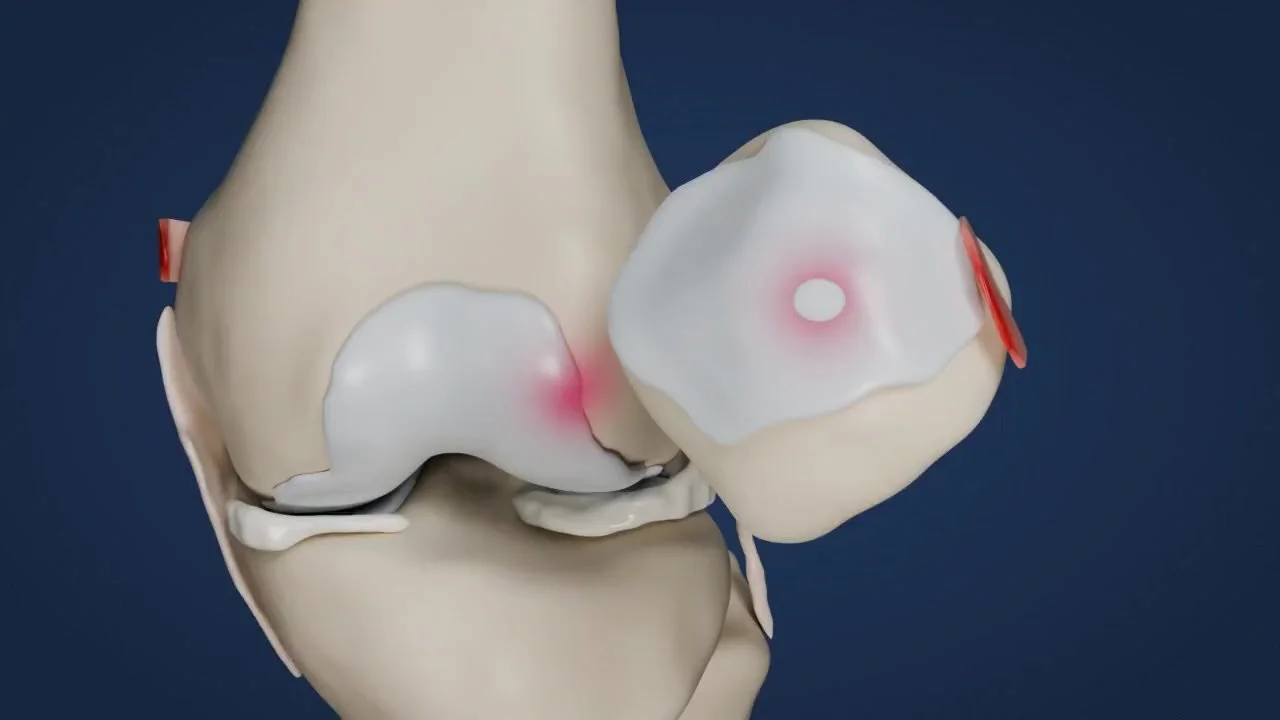
The kneecap rides in a groove at the end of the thigh bone. When your knee is straight, the kneecap sits just above that groove, and as you bend, it has to drop in. As Dr. Raynor tells patients, "when you bend, it has to make the decision: am I going to go into the groove, or am I not?"
A dislocated kneecap almost always goes toward the outside of the knee. To get there, it tears the ligament on the inside of the kneecap, the medial patellofemoral ligament, or MPFL. The MPFL is the check-rein that pulls the kneecap back in when it starts to go the wrong way.
Here is the good news. The ACL sits inside the joint, and once it tears it typically doesn't heal on its own. The MPFL sits outside the joint, much like the MCL, so it can heal.
Why is a first kneecap dislocation usually treated without surgery?
Because most of them heal in. "I like to make it prove it needs it before I just reflexively go do an operation, 'cause I can always do surgery in the future," Dr. Raynor says.
In his practice, a first-time dislocator with normal anatomy usually spends about two weeks in a brace that keeps the knee straight while the ligament settles in. Then comes a kneecap-stabilizing brace and physical therapy to get the knee moving and rebuild the quadriceps, the thigh muscle that helps control the kneecap. Athletes go back when they have full motion, full strength, and can cut, pivot and twist without a deficit; Dr. Raynor likes the quad to test at about 90 percent of the other side. For many, that is around four to six weeks.
A little stiffness along the way is a good sign. "I actually like that it got a little bit stiff," he tells patients. "That stiffness is healing."
The one thing that changes the plan, even after a first dislocation, is a piece of cartilage, sometimes with a piece of bone attached, that breaks off as the kneecap comes out and pops back in (a loose body). An MRI looks for it. If there is one, Dr. Raynor either removes it or fixes it back in place, and that speeds up the timeline: surgery happens soon after the injury instead of waiting to see whether the kneecap comes out again.
What raises the chance of another kneecap dislocation?
The 1 in 3 figure is an average. Your own risk depends on a few things:
Age and growth plates. Younger patients and those whose growth plates are still open are at higher risk (Huntington et al., 2020). In one long-term study of kids who were still growing, about 37 percent had dislocated again by five years and 54 percent by fifteen years (Sanders et al., 2018).
A shallow groove. Some people are born with a groove that is flat, or even rounded like a hill, so the kneecap has little to hold it (Huntington et al., 2020).
A kneecap that rides high. A high-riding kneecap reaches the groove later as the knee bends (Huntington et al., 2020).
The angle of pull. When the patellar tendon attaches far toward the outside of the shin, every contraction of the thigh muscle pulls the kneecap outward. Dr. Raynor measures this on the MRI (Huntington et al., 2020).
A history of instability. In a prospective study, 49 percent of people who had already had kneecap instability had another episode, compared with 17 percent of first-time dislocators (Fithian et al., 2004).
The anatomy and age factors stack. In studies that counted them, with none present, recurrence ran about 8 to 14 percent; with three, it climbed to about 70 to 79 percent (Huntington et al., 2020).
When does a dislocated kneecap need surgery?
"For me, you get one free dislocation," Dr. Raynor says. "And then after that, we start talking about surgery." A kneecap that comes out a second time has shown that the ligament did not heal well enough to hold it. A piece of cartilage and bone that has broken off is the other reason, whether it is a first dislocation or not. It needs to be removed or fixed, and it is the one situation that usually moves surgery up rather than waiting.
Otherwise there is rarely a rush. Because the operation builds a new ligament rather than repairing the old one, it is the same surgery now as a year from now.
What about operating after the first dislocation to prevent a second? In a review of randomized trials, surgery after a first dislocation lowered the rate of further instability (about 11 percent versus 30 percent), but knee function scores were no better than with nonsurgical care (Patel et al., 2026). The authors leaned toward surgery but noted the evidence is not yet strong enough to be definitive. Dr. Raynor weighs that against the fact that most first dislocations never recur.
What is MPFL reconstruction?
MPFL reconstruction builds a new ligament from donor tendon, running from the inside edge of the kneecap to the thigh bone, so it catches the kneecap if it starts to go the wrong way. It is outpatient surgery through small incisions. When the tendon attaches far toward the outside of the shin, Dr. Raynor may also move the bony attachment of the patellar tendon toward the inside to straighten the line of pull, which lengthens the recovery.
Reconstruction makes another dislocation much less likely. Across 14 studies, recurrent instability after isolated MPFL reconstruction was about 1 percent, and 84 percent of patients returned to sports (Schneider et al., 2016). No operation comes with a guarantee.
For more on the condition itself, see kneecap dislocations and patellar instability. If you already have a diagnosis, the Fast Track page explains how to get in quickly.
The Bottom Line
A first kneecap dislocation usually heals without surgery, and about two out of three people in these studies did not have it happen again. Young age, open growth plates and certain anatomy raise the odds. Surgery is for a kneecap that keeps dislocating or a broken-off piece of cartilage and bone that needs to be removed or fixed, and MPFL reconstruction makes another dislocation much less likely.
References
Huntington LS, Webster KE, Devitt BM, Scanlon JP, Feller JA. Factors associated with an increased risk of recurrence after a first-time patellar dislocation: a systematic review and meta-analysis. Am J Sports Med. 2020;48(10):2552-2562. doi:10.1177/0363546519888467 PMID: 31825650.
Sanders TL, Pareek A, Hewett TE, Stuart MJ, Dahm DL, Krych AJ. High rate of recurrent patellar dislocation in skeletally immature patients: a long-term population-based study. Knee Surg Sports Traumatol Arthrosc. 2018;26(4):1037-1043. doi:10.1007/s00167-017-4505-y PMID: 28299386.
Fithian DC, Paxton EW, Stone ML, Silva P, Davis DK, Elias DA, White LM. Epidemiology and natural history of acute patellar dislocation. Am J Sports Med. 2004;32(5):1114-1121. doi:10.1177/0363546503260788 PMID: 15262631.
Patel S, Anaspure OS, Baumann AN, Manz TM, Mistovich RJ. Operative versus nonoperative treatment of medial patellofemoral ligament injuries: a systematic review and meta-analysis of randomized controlled trials with trial sequential analysis. Am J Sports Med. 2026;54(2):475-484. doi:10.1177/03635465251380278 PMID: 41496495.
Schneider DK, Grawe B, Magnussen RA, Ceasar A, Parikh SN, Wall EJ, Colosimo AJ, Kaeding CC, Myer GD. Outcomes after isolated medial patellofemoral ligament reconstruction for the treatment of recurrent lateral patellar dislocations: a systematic review and meta-analysis. Am J Sports Med. 2016;44(11):2993-3005. doi:10.1177/0363546515624673 PMID: 26872895.