
The short answer
Often, no. Meniscus tears show up on MRI in many people who have no knee pain at all, and for the common worn-in tears of middle age, physical therapy works about as well as surgery for most people. Surgery makes sense for a knee that locks, for certain tear patterns such as bucket handle and root tears, and for repairable tears in younger patients.
How common are meniscus tears in people with no knee pain?
Very common. In a study that scanned the knees of nearly 1,000 community adults aged 50 to 90, chosen without regard to knee trouble, a meniscus tear showed up in anywhere from 19% of women in their 50s to 56% of men 70 and older. And 61% of the people with a tear had no pain, aching, or stiffness in the previous month (Englund et al., 2008). Pooling 63 studies of adults with no knee pain and no prior injury, in studies of adults averaging 40 or older, about 1 in 5 had a meniscus tear on MRI (Culvenor et al., 2019).
Dr. Raynor's summary for patients: "They don't all hurt. They don't all continue to hurt. They do not all need surgery."
Is my torn meniscus degenerative or traumatic?
The menisci are two shock-absorbing discs that sit between the thighbone and the shinbone. Tears come in two broad types.
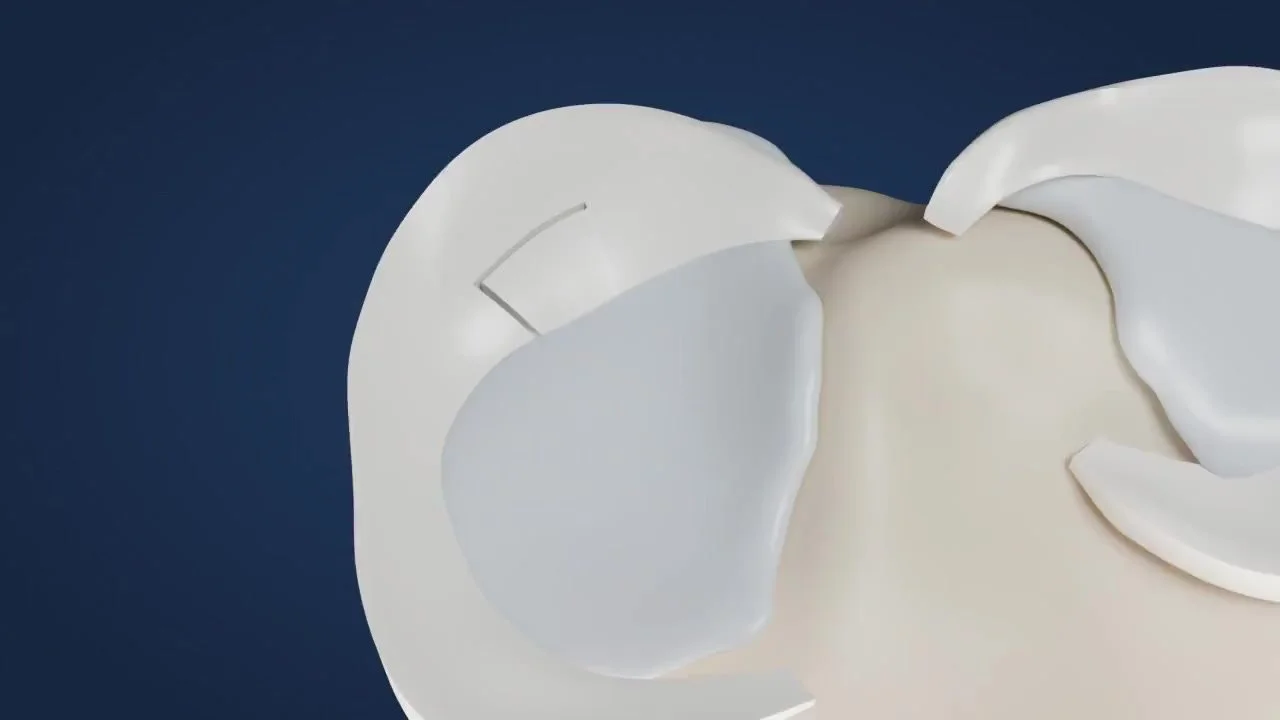
Degenerative tears come with age. The most common is a horizontal tear in the back of the inner (medial) meniscus, which Dr. Raynor describes as a pita pocket: the meniscus splits into a top layer and a bottom layer. A loose flap can irritate the knee so that it swells and aches, and then it often settles back down.
Traumatic tears happen with a twist or pivot, often in a younger athlete and sometimes with an ACL tear. These are more likely to be stitchable.
Why try physical therapy first for a degenerative meniscus tear?
Because the best studies support it. Three randomized trials point the same way:
In a Finnish trial of 146 people aged 35 to 65 with a degenerative tear and no arthritis, trimming the meniscus was no better than a sham operation at one year (Sihvonen et al., 2013).
In a U.S. trial of 351 people 45 and older with a tear and mild to moderate arthritis, physical therapy and surgery produced similar improvement in function at 6 months, although 30% of the therapy group had surgery during that time (Katz et al., 2013).
In a Norwegian trial of 140 middle-aged adults, 12 weeks of supervised exercise matched surgery at two years and built stronger thighs by three months. The 19% who later switched to surgery gained no additional benefit (Kise et al., 2016).
In Dr. Raynor's words, "PT is never the wrong answer." An injection can calm an angry knee enough to let therapy work. And while you try, "You're not harming your knee."
When does a meniscus tear need surgery?
Those trials studied worn-in tears in middle-aged knees. They do not apply to every tear. Dr. Raynor recommends surgery when:
The knee locks or will not straighten. A large torn piece that flips into the joint, called a bucket handle tear, can jam the knee. That is a mechanical problem therapy cannot fix.
The tear is at the root, where the meniscus anchors to the bone. In a cadaver study from the University of Pittsburgh, a tear of the back root of the medial meniscus raised peak pressure on the inner side of the knee by 25%, the same as removing the entire medial meniscus, and repairing the root restored it to normal (Allaire et al., 2008). Across studies that followed patients for an average of five to seven years, arthritis progressed in 22% of repaired roots versus 66% of roots treated by trimming, and 10% versus 36% went on to knee replacement (Krivicich et al., 2022). Repair is linked to lower odds of arthritis; it does not eliminate them. For an older knee that already has arthritis, Dr. Raynor may manage a root tear without surgery.
A younger patient has a repairable tear, especially after an injury.
A degenerative tear keeps coming back after therapy and an injection or two, and it hurts right where the meniscus is torn.
Should my meniscus be repaired or trimmed?
That depends on where the tear sits and its shape. Dr. Raynor explains the meniscus in zones. The outer red zone has a blood supply, and tears there can heal when stitched. The inner white zone does not, so torn pieces there are trimmed away and the rest is smoothed and kept.
Trimming is the quicker recovery: you walk on the knee right away with no restrictions. Most people feel pretty good in three or four weeks and really good by about two months. Dr. Raynor removes only the torn part because, as he explains, losing more meniscus raises the long-term risk of arthritis. As he tells patients, "The medial meniscus tolerates this very well. The lateral meniscus doesn't take a joke."
Repair keeps your shock absorber for life, at the cost of a slower recovery. With one or two stitches, Dr. Raynor usually changes nothing about walking. With more than that, patients walk with the leg straight for six weeks. A root repair means toe-touch weight bearing on crutches for six weeks. And because the meniscus has a limited blood supply, not every repair heals.
The meniscus repair recovery roadmap and the knee arthroscopy recovery roadmap walk through each recovery stage by stage.
The Bottom Line
A meniscus tear on your MRI is common, and on its own it is not a reason for surgery. For a worn-in tear, the research supports therapy first. A locked knee, a root tear, or a repairable tear in a younger knee is a different conversation. More on tear types and treatment is on the meniscus tears page, and if an injury has left your knee locked or unstable, the Fast Track page explains how to be seen quickly.
References
Englund M, Guermazi A, Gale D, et al. Incidental meniscal findings on knee MRI in middle-aged and elderly persons. N Engl J Med. 2008;359(11):1108-1115. doi:10.1056/NEJMoa0800777 PMID: 18784100.
Culvenor AG, Øiestad BE, Hart HF, et al. Prevalence of knee osteoarthritis features on magnetic resonance imaging in asymptomatic uninjured adults: a systematic review and meta-analysis. Br J Sports Med. 2019;53(20):1268-1278. doi:10.1136/bjsports-2018-099257 PMID: 29886437.
Sihvonen R, Paavola M, Malmivaara A, et al. Arthroscopic partial meniscectomy versus sham surgery for a degenerative meniscal tear. N Engl J Med. 2013;369(26):2515-2524. doi:10.1056/NEJMoa1305189 PMID: 24369076.
Katz JN, Brophy RH, Chaisson CE, et al. Surgery versus physical therapy for a meniscal tear and osteoarthritis. N Engl J Med. 2013;368(18):1675-1684. doi:10.1056/NEJMoa1301408 PMID: 23506518.
Kise NJ, Risberg MA, Stensrud S, et al. Exercise therapy versus arthroscopic partial meniscectomy for degenerative meniscal tear in middle aged patients: randomised controlled trial with two year follow-up. BMJ. 2016;354:i3740. doi:10.1136/bmj.i3740 PMID: 27440192.
Allaire R, Muriuki M, Gilbertson L, Harner CD. Biomechanical consequences of a tear of the posterior root of the medial meniscus. Similar to total meniscectomy. J Bone Joint Surg Am. 2008;90(9):1922-1931. doi:10.2106/JBJS.G.00748 PMID: 18762653.
Krivicich LM, Kunze KN, Parvaresh KC, et al. Comparison of long-term radiographic outcomes and rate and time for conversion to total knee arthroplasty between repair and meniscectomy for medial meniscus posterior root tears: a systematic review and meta-analysis. Am J Sports Med. 2022;50(7):2023-2031. doi:10.1177/03635465211017514 PMID: 34251898.