
The short answer
A dislocated shoulder does not always need surgery, but the younger and more active you are, the more likely the answer is yes. Without surgery, about two out of three people aged 15 to 35 have another episode of instability within five years, and young men are at the highest risk (Robinson et al., 2006). Dr. Brett Raynor, a sports medicine surgeon in Dallas, treats many first dislocations with rehabilitation and recommends an arthroscopic labral repair when the shoulder keeps coming out or when the risk of another dislocation is high.
What tears when a shoulder dislocates?
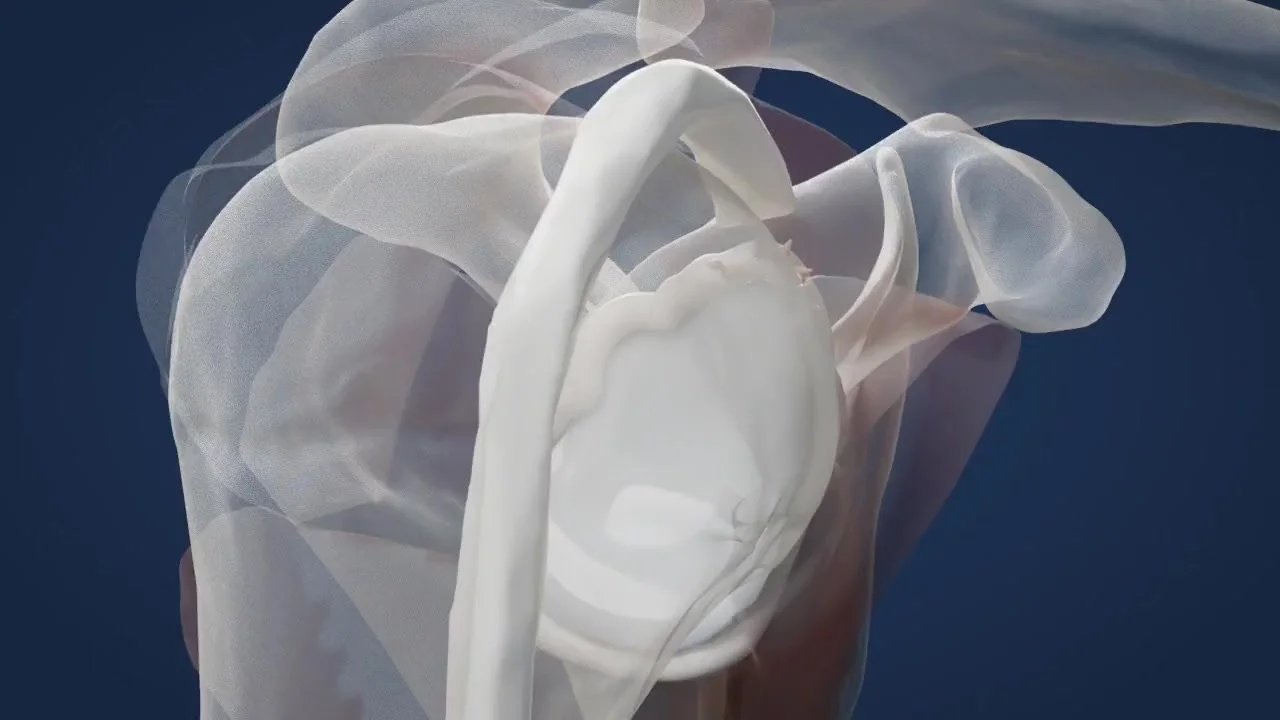
The shoulder is a ball and socket, but the socket is shallow, like a golf ball sitting on a tee. Around the edge of the socket is the labrum. As Dr. Raynor describes it, "the labrum is a little bumper that goes around the edge of it." Ligaments attach to that bumper and help keep the ball centered.
Most dislocations happen out the front, often with the arm up and out to the side. On the way out, the ball tears the labrum and its ligaments off the front edge of the socket. Surgeons call this a Bankart tear. In young patients examined with a camera within ten days of a first dislocation, 97 percent had this tear (Taylor and Arciero, 1997).
The hope after a dislocation is that the labrum scars back down where it belongs. When the shoulder keeps coming out, it shows the tear did not heal well enough to hold the ball on the tee.
Why are young, active people more likely to dislocate their shoulder again?
Age at the first dislocation is one of the strongest predictors of shoulder dislocation recurrence (Olds et al., 2015). In a prospective study of 252 patients aged 15 to 35 treated with a sling and physical therapy, 56 percent had another episode of instability within two years and 67 percent within five years. Young men had the highest risk, and most repeat episodes happened in the first two years (Robinson et al., 2006).
A review of adult studies found an overall recurrence rate of 39 percent, with much higher odds in people 40 or younger (about 13 times), in men (about 3 times), and in people with naturally loose joints (about 2.7 times) (Olds et al., 2015). In the youngest, most active group, patients under 24, 90 percent of those treated without surgery developed recurrent instability (Taylor and Arciero, 1997).
As Dr. Raynor explains, each time the shoulder comes out, the tear can get bigger and the ligaments stretch further.
Can a dislocated shoulder be treated without surgery?
"What do we do about you? What's our plan? We have options," Dr. Raynor tells patients, and rehabilitation is always one of them. A sling is worn for a short time, mostly for comfort. Longer is not better: in patients under 30, three weeks or more in a sling did not lower the chance of another dislocation compared with a week or less (Paterson et al., 2010).
Physical therapy then strengthens the rotator cuff and the muscles that steer the shoulder blade, which help hold the ball in the socket. "Having good scapular muscles really helps us sit your shoulder in space and helps your shoulder out," he says. "So don't skip back day." While the shoulder recovers, avoid the position it came out in: arm up, out to the side, and rotated back.
If the shoulder feels stable after rehabilitation, surgery is not needed. For an athlete who dislocates mid-season, Dr. Raynor often plans with the family and athletic trainer to finish the season, knowing it may come out again, and repair it afterward.
Who needs surgery after a shoulder dislocation?
Dr. Raynor recommends surgery when:
The shoulder has dislocated more than once
It still feels unstable after a course of physical therapy
A young contact or overhead athlete has had a first dislocation and wants one repair and one recovery rather than a recurring problem
The shoulder cannot be trusted in the positions a sport or job requires
The research supports repairing high-risk shoulders early. Across ten prospective studies of first-time dislocations, about 10 percent of shoulders had recurrent instability after arthroscopic repair, compared with 67 percent after rehabilitation alone, and more surgical patients returned to play (93 percent versus 81 percent) (Hurley et al., 2020). For people over 40, a first dislocation is less likely to recur, so rehabilitation usually comes first.
What is labral repair surgery, and what is recovery like?
An arthroscopic labral repair is outpatient surgery through a few small incisions. Small anchors made of suture, usually three or four, reattach the labrum and ligaments to the edge of the socket and take up the slack.
In Dr. Raynor's practice, the sling stays on for six weeks whenever you are up and around and while you sleep. Once the nerve block has worn off and you have control of the arm, it can come off to shower, eat or use a computer, with the elbow kept by your side. Physical therapy starts within days. The next six weeks are about getting motion back, and strengthening begins at three months. Most athletes return to sports between four and six months, and nobody plays competitive sports before four months. Across 34 studies, 81 percent of athletes returned to sport after arthroscopic repair (Memon et al., 2018). As he likes to say, "PT is never the wrong answer," and it does a lot of the work here.
For the full picture, see shoulder dislocations and instability and the recovery roadmaps. If you already have a diagnosis, the Fast Track page explains how to get in quickly.
The Bottom Line
A dislocated shoulder usually tears the labrum, the bumper around the socket. Many people do well with therapy alone. But for teens and young adults, especially young men in contact sports, the odds of it coming out again are high, and an arthroscopic labral repair makes another dislocation much less likely.
References
Robinson CM, Howes J, Murdoch H, Will E, Graham C. Functional outcome and risk of recurrent instability after primary traumatic anterior shoulder dislocation in young patients. J Bone Joint Surg Am. 2006;88(11):2326-2336. doi:10.2106/JBJS.E.01327 PMID: 17079387.
Taylor DC, Arciero RA. Pathologic changes associated with shoulder dislocations: arthroscopic and physical examination findings in first-time, traumatic anterior dislocations. Am J Sports Med. 1997;25(3):306-311. doi:10.1177/036354659702500306 PMID: 9167808.
Olds M, Ellis R, Donaldson K, Parmar P, Kersten P. Risk factors which predispose first-time traumatic anterior shoulder dislocations to recurrent instability in adults: a systematic review and meta-analysis. Br J Sports Med. 2015;49(14):913-922. doi:10.1136/bjsports-2014-094342 PMID: 25900943.
Paterson WH, Throckmorton TW, Koester M, Azar FM, Kuhn JE. Position and duration of immobilization after primary anterior shoulder dislocation: a systematic review and meta-analysis of the literature. J Bone Joint Surg Am. 2010;92(18):2924-2933. doi:10.2106/JBJS.J.00631 PMID: 21159993.
Hurley ET, Manjunath AK, Bloom DA, Pauzenberger L, Mullett H, Alaia MJ, Strauss EJ. Arthroscopic Bankart repair versus conservative management for first-time traumatic anterior shoulder instability: a systematic review and meta-analysis. Arthroscopy. 2020;36(9):2526-2532. doi:10.1016/j.arthro.2020.04.046 PMID: 32389771.
Memon M, Kay J, Cadet ER, Shahsavar S, Simunovic N, Ayeni OR. Return to sport following arthroscopic Bankart repair: a systematic review. J Shoulder Elbow Surg. 2018;27(7):1342-1347. doi:10.1016/j.jse.2018.02.044 PMID: 29622461.